
30 Jun 2026 Danish Hunters Gather Key Data for Sustainable Eider Hunting
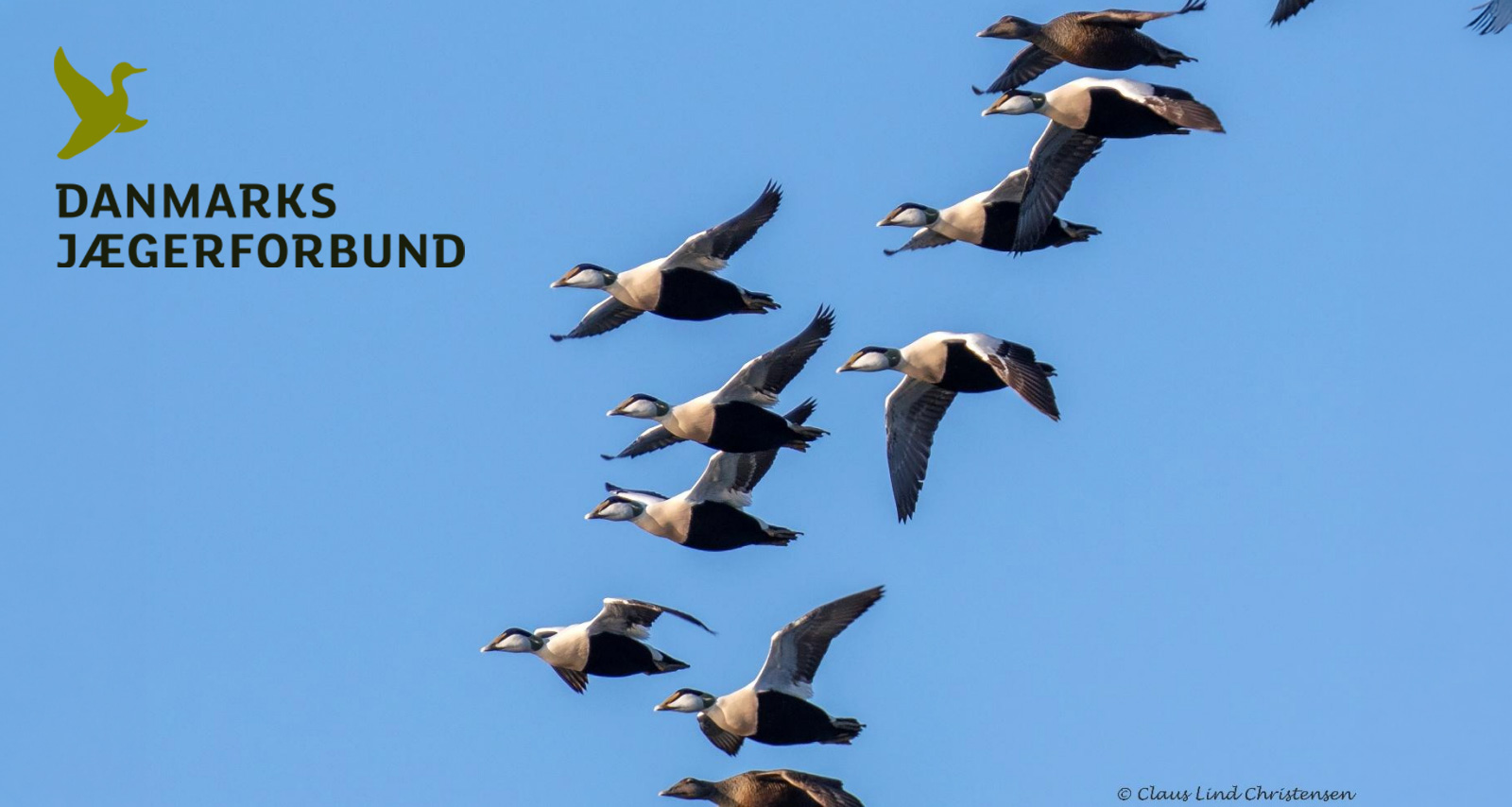
The Danish Hunters’ Association contributes actively to population monitoring in close cooperation with universities, public authorities and a nationwide network of highly committed volunteer hunters. Most recently, in March 2026, the Danish Hunters’ Association coordinated a survey of the sex ratio of common eiders across Denmark.
In Denmark, male eiders are huntable, while females are protected. Despite this management approach, monitoring has consistently shown a skewed sex ratio, with more males than females. To track how this ratio develops over time, the Danish Hunters’ Association carries out the survey every two years. The results from the March 2026 survey have now been published in a report available in Danish.
Abstract: Population monitoring is a key activity for ensuring a robust data basis for assessing the sustainability of hunting on wild species, including the common eider (Somateria mollissima). As existing data sources, such as hunting bag statistics, have limitations, supplementary studies are necessary to provide insights into population structure, including sex and age composition. As the eider population is declining and females constitute the limiting factor for reproduction, monitoring sex ratios is of particular importance. In March 2026, a nationwide count of eiders was conducted by volunteer hunters. A total of 22,090 birds were recorded across 58 locations in Denmark. The results showed a clear male bias, with 63.3% males and 36.7% females. Compared to previous years, the 2026 sex ratio has returned to the level observed in 2011, following a period with a higher proportion of males in 2021 and 2024. Significant geographical variation in sex ratios was observed among different marine areas, though without a clear overall pattern. Despite methodological uncertainties, the study confirms a persistent skewed sex ratio with a surplus of males.
The Danish Hunters’ Association makes the data available for scientific analyses, which may contribute to the sustainable management of the eider population in Denmark.
👉 View the full Report at this link