
20 Oct 2026 Ten Years of Cooperation Support Grey Partridge Recovery in Fellbach, Germany
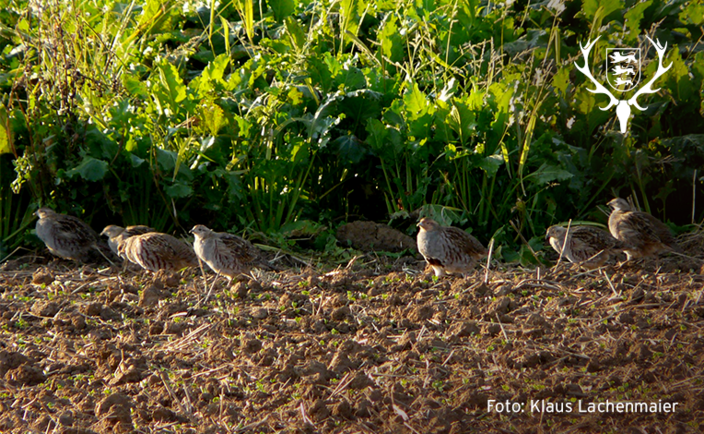
Long-term cooperation between hunters, farmers, conservation organisations and public authorities is delivering encouraging results for the Grey Partridge in Fellbach, Germany. In spring 2026, 31 territories were recorded in the Schmidener Feld, more than three times the number counted in 2019.
The initiative began in 2016 following a severe decline from 120 territories in 2000 to only ten in 2019. The Rems-Murr District nature conservation authority, the Rems-Murr Landscape Conservation Association, the City of Fellbach, NABU Fellbach, local farmers, the Landesjagdverband Baden-Württemberg e.V. LJV BW – which is the State Hunting Association, member of the Deutscher Jagdverband (DJV) – and the Waiblingen District Hunters’ Association joined forces to reverse this trend.
Since 2023, the Schmidener Feld has formed part of the national project “Saving the Grey Partridge, Promoting Biodiversity”. In Baden-Württemberg, NABU Baden-Württemberg leads the regional project in close cooperation with LJV BW, one of the initiative’s main actors. Together, they support stakeholder advice, habitat restoration, population monitoring and measures to reduce predation risk.
Farmers have created multiannual flowering areas, low-density cereal fields, field margins and other sources of food and cover. Hunters contribute by helping to plan habitat measures, monitoring grey partridge populations and implementing predator management alongside habitat improvements. These actions are designed to provide suitable nesting sites, year-round food and secure cover across the agricultural landscape.
“The more diverse the available cover, the greater the likelihood that grey partridges can conceal themselves successfully. Effective conservation also depends on knowing where the species occurs. NABU Fellbach and the local hunting community therefore play a vital role by continuously monitoring the population and providing valuable information on its distribution and development. Their joint commitment demonstrates that successful Grey Partridge conservation in Fellbach relies on the sustained efforts of many partners.”
René Greiner, Managing Director of LJV BW
The measures also benefit other farmland species, including brown hare, skylark, butterflies and wild bees. The results from Fellbach demonstrate how sustained cooperation, habitat restoration and coordinated wildlife management can support biodiversity in intensively used agricultural landscapes.
As part of the “Saving Partridges – Promoting Biodiversity” project, biodiversity enhancement measures were scientifically monitored across ten project regions in several German federal states, and their effects on different species groups were assessed. The results demonstrate that these measures benefit not only the grey partridge but also other farmland bird species and moths. Surveys showed that monitoring points located near perennial flower-rich habitats supported approximately 20% higher bird species richness and individual abundance compared to reference sites without such measures. Similar surveys conducted in Fellbach produced the same outcome, confirming higher species richness and abundance of farmland birds in areas with flower-rich habitats. Likewise, moth monitoring revealed a greater abundance and higher species diversity of nocturnal moths on flower-rich areas than on comparable cereal field sites. These findings highlight the important role of structurally diverse, perennial flowering habitats as effective tools for enhancing biodiversity in agricultural landscapes.
 PDF
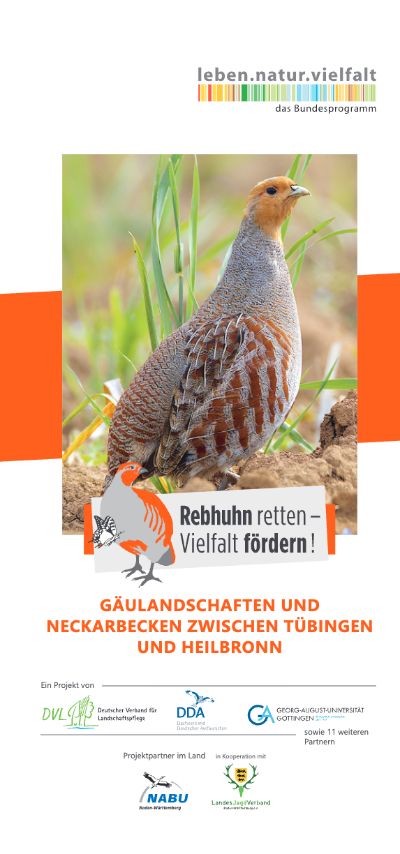
Rebhuhn retten – Vielfalt fördern
Saving the Grey Partridge, Promoting Biodiversity: the national project, its partners and the habitat measures in Baden-Württemberg.
Download the flyer ↓ Read the LJV BW news (DE) →