
29 May 2026 Albania Moves Towards a New Chapter for Sustainable Hunting and Wildlife Management
Tirana / Brussels / Vienna – 22 May 2026 – After more than a decade of hunting moratorium, Albania is now moving towards a new framework for sustainable hunting and wildlife management, supported by a broad coalition of government representatives, hunters, conservationists, and international organisations.
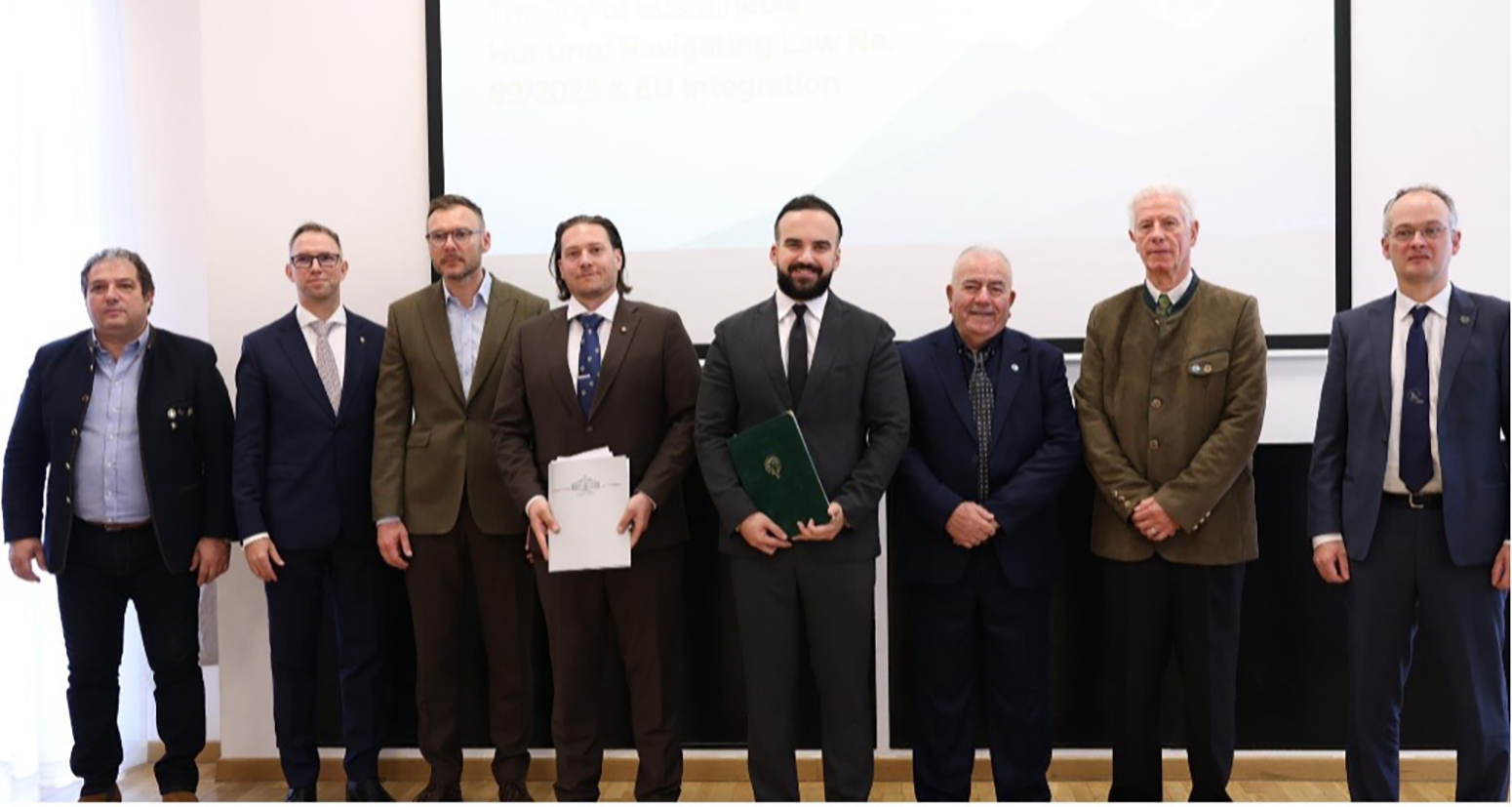
To support this process, the Albanian Federation for Hunting and Conservation hosted a high-level round table in Tirana on 22 May 2026 together with the Ministry of Tourism and Environment, bringing together national stakeholders alongside representatives from the European Federation for Hunting and Conservation (FACE) and the International Council for Game and Wildlife Conservation (CIC). The event also marked Albania’s formal accession to the CIC as a State Member.
For more than ten years, hunting in Albania has been suspended under successive extensions of a national moratorium. However, the adoption of the new hunting law (Law 89/2025) and growing political and societal support for regulated hunting have created momentum for reopening hunting under a modern governance framework later this year.
Importantly, discussions in Tirana demonstrated growing consensus among hunting and conservation organisations that responsible wildlife management, supported by strong governance and local participation, offers the most credible path forward for Albania’s wildlife and rural communities.
National conservation organisations, including the Albanian Ornithological Society (AOS) and PPNEA, highlighted their positive experiences working alongside Albanian hunters on conservation initiatives. These include cooperation on Balkan Lynx and Brown Bear projects, bird identification workshops for hunters, and quail monitoring using pointing dogs to assist field surveys.
Participants acknowledged that the prolonged moratorium has also created significant challenges. In several areas, poaching increased during the ban, while long-term wildlife monitoring and local field presence weakened considerably. Stakeholders stressed that the absence of regulated hunting does not automatically result in effective wildlife conservation and that future success will depend on practical management systems, enforcement, and local engagement.
Discussions focused on the practical implementation of Albania’s evolving hunting framework, including the stabilisation of hunting territories, ranger systems, licensing and testing for hunters, management of hunting fees, wildlife health and vaccination measures, and the future role of local hunting associations.
FACE and CIC emphasised the importance of maintaining strong communication between local and national levels and ensuring that local hunting associations continue to play a central role in implementation under the coordination of the national federation. Participants also highlighted the importance of aligning Albania’s future framework with international conservation agreements, including AEWA and the European Charter on Hunting and Biodiversity.
Srečko Žerjav, Vice President of FACE, underlined the wider European experience: “Across the 37 countries represented within FACE, hunting traditions, species, and management systems vary greatly, but the importance of strong national federations and clear governance structures remains constant.”
CIC Programme Coordinator Thomas Paulic emphasised the contribution hunters can make when operating within effective governance systems: “You do not need to convince good hunters to spend time in nature, monitor wildlife, or protect habitat. What they need are the frameworks, authority, and incentives to make those efforts effective and sustainable.”
The Albanian Federation for Hunting and Conservation was also recognised for remaining active throughout the moratorium period, with its regional associations continuing to support wildlife crime detection and reporting during difficult years for the sector.
Stakeholders agreed that Albania now has an important opportunity to move from moratorium towards a long-term governance model capable of delivering real outcomes for wildlife, habitats, and local communities.
Related background – CIC and FACE Welcome Albania’s Decision to Reopen Hunting